
Feature
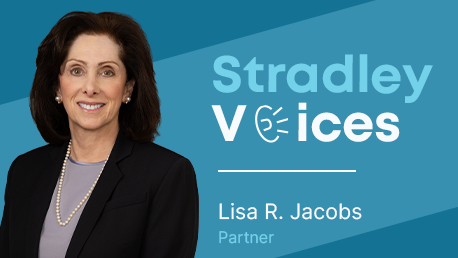
Stradley Voices: Q&A with Partner Lisa Jacobs on Uniform Law Commission
November 17, 2025
share this page
Stradley Ronon partner Lisa Jacobs was recently elected as the 58th president of the Uniform Law Commission (ULC) for a two-year term. Established in 1892, the ULC provides states with nonpartisan, well-drafted legislation to bring clarity and stability to key areas of state statutory law. Members are lawyers and include appointed representatives from all 50 states, as well as the District of Columbia, Puerto Rico and the U.S. Virgin Islands.
In the inaugural edition of our Stradley Voices series — where we provide a brief look into the varied experiences and dedicated efforts by our people across the firm — Lisa discusses her more than 15 years of service with the ULC, including her duties as president, the role the commission plays in national public policy discourse, her proudest accomplishments with the commission, and projects the commission is working on now.
Q: When and in what capacity did you begin working with the ULC?
A: I started out serving in several advisory capacities to ULC drafting committees in 2007, when Pennsylvania was looking to adopt ULC products and its deliberations resulted in the ULC revisiting a number of issues. In 2012, I was appointed as a Pennsylvania Uniform Law Commissioner. During my tenure with the ULC thus far, I have served as chair or member of numerous drafting, study, ad hoc and standing committees, many of which focused on business organizations and commerce. Before being elected president, I was most recently chair of the ULC’s Executive Committee, a position to which I was appointed in 2023; prior to that I chaired the ULC’s Committee on Scope and Program, the body that determines what projects the ULC will be undertaking during the year.
Q: Can you describe briefly your history with the commission?
A: Over the years, I have served on numerous drafting and study committees. Currently, I chair the drafting committee for the Amendments to the Harmonized Business Organizations Acts — nine separate and related acts that were approved for enactment in 2024. I previously served in the capacities noted above; was the chair of the first effort of the ULC to address diversity and inclusion matters; was involved in committees that revised the ULC governance documents; and served on drafting committees for the Limited Liability Company Protected Series Act, the Employee and Student Online Privacy Protection Act, and the Registration of Canadian Money Judgments Act.
To provide one example of my work, as a result of my work with the ULC committees that developed the uniform acts, in 2017, I played a lead role in changing Pennsylvania law in modernizing and amending Pennsylvania’s Title 15 — with Act 170, and then again in 2022 with Act 122, which established, among other changes, annual reporting requirements (rather than the historical decennial reporting) for businesses in the Commonwealth.
Q: What will you be doing in your role as president?
A: The ULC’s overarching mission is evidenced by its name — uniformity — an objective that is not possible without engagement. Internally, I intend to focus on optimizing the participation of each of our members — driving the accomplishments that are best achieved by fostering that involvement — in order to ensure we are each bringing our passion to the mission.
Externally, I am examining how we can leverage our presence and reputation as an organization to strengthen and build upon our relationships with external organizations and other stakeholders such as the American Bar Association (ABA), the Uniform Law Conference of Canada, the American Law Institute, the academic and judicial communities, federal and state legislators and related associations, other trade and industry groups, and a plethora of practitioner “experts” across the country. Those partnerships are paramount to promoting and ensuring our ability to impact the state of state law.
Q: In your view, what is the significance of having uniformity in state legislation?
A: Under the concepts of federalism, the federal government may exercise only those powers specifically granted to it by the U.S. Constitution. Specifically, Article I, Section 8 enumerates the powers over which Congress has exclusive authority. These are typically national in scope, such as taxes and Treasury matters, treaties, coining of currency, defense and national security, national militia, and the like. While there are more concepts that have evolved from the federal government’s exercise of preemption rights and the exercise of concurrent authority from time to time, under the 10th Amendment to the Constitution, powers not delegated to the United States by the Constitution, nor prohibited by it to the states, are reserved to the states.
Because much of the regulation of intrastate commerce lies with the states (rather than the federal government), inconsistencies among state laws make it challenging for individuals and entities acting in areas involving multiple states. For example, the increase in hybrid and remote work arrangements has brought up complexities for employers in navigating various state tax, worker classification and privacy laws. The ULC’s work in drafting and proposing uniform state laws, rules and procedures helps to address these conflicts of laws among the several states and facilitates the flow of commercial activities both across state lines and with non-U.S. entities, allowing for reciprocity of rights and remedies between states and their residents and resolving other multijurisdictional conflicts.
Q: What are some of the other benefits the ULC’s work provides?
A: Beyond uniformity, the ULC also works to update antiquated legal constructs, bringing much-needed modernization to state statutory law. In addition, the commission’s projects assist states with highly technical areas of law and address new, evolving and emergent legal needs, providing an infrastructure that is not inherent in most state legislatures. These efforts aim to maintain state sovereignty and lessen the likelihood of the above-noted federal preemption while simultaneously allowing for a harmonious legal system among the states. Other contributions of the ULC include projects to codify areas governed by common law.
Q: What are a few examples of the types of legal issues the ULC addresses in its work?
A: The substantive areas of law in which the ULC engages include commercial law, business entity formation and governance, family/domestic relations law, estates/probate/trusts, real estate transactions, implementation of full faith and credit, interstate enforcement of judgments, alternative dispute resolution and administrative procedure. The ULC’s impact on interstate commerce is reflected in its most recognizable product: the Uniform Commercial Code (UCC). Other notable uniform acts that have been widely recognized include the Uniform Anatomical Gift Act, Uniform Probate Code, Uniform Common Interest Ownership Act, Uniform Determination of Death Act, Uniform Enforcement of Foreign Judgments Act, Uniform Partnership and Limited Partnership Acts, Uniform Limited Liability Company Act, Uniform Voidable Transactions Act, Uniform Law on Notarial Acts, and other various business organization entities acts.
The ULC has also engaged with the indigenous peoples of the United States in a number of tribal-facing projects including one currently under way: the implementation of the 1978 federal Indian Child Welfare Act. Finally, the ULC works on the state implementation of international treaties into which the federal government (typically, the U.S. Department of State) has entered.
Q: How does your business law experience come into play when working to shape national public policy?
A: Because so much of my private law practice focuses on business organization creation, finance, structure and governance, my practical experience often intersects with the acts the ULC is considering. Many of the skills I have developed in my day-to-day practice relate to my work with the ULC, particularly when it comes to striving toward and achieving a fair, practical and enactable statute. My capabilities in developing consensus, promoting and fostering collegiality, and balancing varying agendas in my legal work are also paramount in the work I do with the commission.
Q: The ULC states it provides rules and procedures that are consistent between and among states but that also recognize each state’s diverse experience. As a current Pennsylvania Uniform Law Commissioner, how do you balance the state’s desires with that of others?
A: Each proposed act requires a balanced, philosophical approach. Without giving consideration to the distinctions among the states — whether economic, political, philosophical or cultural — widespread adoption would not be possible, and that is our goal. We respect the diversity of each state while at the same time working toward the larger mission of unifying laws among them. Those states in turn reap benefits such as reduced uncertainty, costs and variation. Of course, sometimes uniformity is not possible. The ULC acts can nonetheless provide guidance on important issues even if a state adopts only a portion — or a modified version — of an act developed by the ULC.
Q: What is your proudest moment or accomplishment during your ULC tenure?
A: One of the highlights of my work with the ULC was the launch of the commission’s diversity and inclusion committee (an interesting challenge where, unlike most organizations, the ULC does not select its members — they are appointed by the various states and territories). I repeatedly advocated for the creation of this committee with then-ULC President Rich Cassidy, and in 2014, he formed the committee on which I served and chaired. The committee’s goal was to review and revise ULC policy and procedure to foster our hallmark discipline: ensuring the consideration of a diversity of viewpoints in the drafting of our acts so that the ULC can produce work that is not only geographically inclusive but well considered from a plethora of vantage points.
I also was thrilled to be appointed in 2013 as the first woman member of the Joint Editorial Board for Uniform Unincorporated Organizations Acts, a body of ULC and ABA members knowledgeable on these laws who are well positioned to evaluate the need for revisions and updates. That position gave me firsthand experience in addressing the challenge of ensuring that all voices are represented when drafting state laws that are crafted with the goal of being implemented across multiple jurisdictions. Finally, my current position, while not something for which I campaigned, is offering me countless opportunities to make a small mark on the development of state laws in our country.
Q: How does your ULC work inform or enhance your legal practice?
A: During my years on the commission, I have been able to help shape the future of numerous uniform state laws on a national scale — many of which I took the lead in drafting — and therefore am intimately familiar with the acts that come up in day-to-day practice. This has not only benefited my clients but also my colleagues. I am able to leverage my experience along with the ULC’s nationwide network of commissioners — lawyers, judges, legislators and law professors — to serve as a go-to resource on UCC rules, business governance matters and other laws arising in a wide array of matters.
Q: What do you think others might not know about the ULC that would be beneficial?
A: Two thoughts come to mind. First, many practitioners are likely unaware of the breadth of the acts that have been produced by the ULC. As described above, they focus on so many areas of our lives and our work and have led to fairness and equity and a more rational approach to those legal constructs. Secondly, our process is unique in the world of legislative drafting. Our commissioners serve, without compensation, on study, drafting and other committees that do the work of the commission. Commissioners represent their appointed states and leave their special interests at the door. Commissioners (and not lobbying groups) are the primary driving force behind enactments in their states. Unlike many other legislative drafting processes, the ULC process is open to the public and considers input from legal experts, advisers, and industry and academic “observers,” allowing for a cross-section of interest groups that could be affected by the proposed laws to make their views known.
Each act typically has a two-year process, usually following a one-year “study” process. Each proposed act is read line by line during at least two annual meetings (a convention of commissioners) and each individual commissioner has an opportunity to provide questions and comments. A quote from the late U.S. Supreme Court Chief Justice William Rehnquist (and former ULC commissioner) says it all: “[M]y most vivid recollection of the annual meetings is the high quality of the floor debate about a pending proposed uniform law.”
Q: What are some of the projects the ULC is focused on now?
A: The Occupational Licenses of Servicemembers and Military Spouses Committee, formed in 2024, is currently working on drafting an act that aims to provide professional licenses for servicemembers, military spouses and veterans in states to which the servicemember is drafted. Another project nearing completion is a comprehensive rationalization of conflicts of laws in trusts and estates matters. A third is focused on commercial finance disclosures required by lenders who are not already subject to federal disclosure laws such as the Truth in Lending Act, Regulation Z (governing consumer finance), or federally governed banks. These entities might be hard-money lenders, payday loan providers, factoring companies, and the like.
At our most recent annual meeting, in July 2025, the ULC approved for enactment two of its proposed acts: (1) an act governing assignments for the benefit of creditors — a viable alternative to expensive and time-consuming bankruptcy cases and hard-to-manage foreclosures and receiverships; and (2) the Uniform Judicial Interview of Children Act, which provides a comprehensive framework for conducting judicial interviews of children in family law civil proceedings in which children’s views are relevant. The act seeks to balances two compelling, sometimes competing interests: protecting a child when the child’s views are elicited by a judicial officer and protecting the due process rights of the parties.
Another project, currently in the study committee stage, is exploring a potential uniform or model act on mental privacy, the use of biometrics, and the potential misuse of neural data. An additional study committee is looking at the need for an act related to the ownership of pets in family dissolution matters. These are just some examples of the multidisciplinary efforts currently in the works by the many study and drafting committees across the commission.
Stay tuned — some of these products will be coming soon to a legislature near you!











.png)
