
Feature
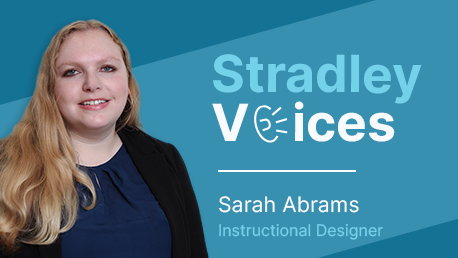
Stradley Voices: Q&A with Sarah Abrams on the Intersection of Music and Law
July 28, 2026
share this page
In this edition of our Stradley Voices series — spotlighting the varied experiences and dedication of our people across the firm — Sarah Abrams shares her career journey, reflecting on the fortuitous convergence of her work in music and legal services.
A professional flautist and music teacher, Sarah pairs her passion for music with her role as a member of Stradley Ronon’s knowledge management team. Starting out as a legal administrative assistant in the firm’s investment management practice in 2020, Sarah stepped into her current position as an instructional designer last year, contributing to the firm’s generative AI and KM learning initiatives.
Q: When and in what capacity did you join Stradley Ronon?
A: Right before the pandemic hit in 2020, I graduated with my master’s degree in music performance from New York University. I had heard that many musicians work in the legal industry because both involve a similar way of thinking. I joined Stradley Ronon that February as a legal administrative assistant in the investment management practice and remained in that position for five years.
Q: What is your background in music?

A: I knew I wanted to get into music since I was a kid. My dad plays music and many members of my family are musicians, including my brothers. Currently, I regularly perform as a flautist and teach music lessons. I am grateful because my job at Stradley Ronon has allowed me to pursue both interests.
Q: What similarities have you found between music and the law?
I didn’t truly understand the overlap between the law and music until I had been at the firm for a while — that my brain approaches both in a similar way. You're always learning, refining your craft, and paying attention to nuance. In both fields, the details matter — a small change in phrasing, emphasis or interpretation can completely change the outcome.
The connection became even clearer to me through teaching. When I teach flute, if a student plays all the correct notes and rhythms but doesn't use dynamics (changes in the volume level), they sometimes ask why dynamics matter at all. Rather than trying to explain it with words, I play the passage twice — once with dynamics and once without. As soon as they hear the contrast, they understand that the notes and rhythms alone aren’t the whole story.
I've found that same principle applies to my work in knowledge management and instructional design. Whether I'm introducing a new AI tool or demonstrating a more efficient workflow, people understand the value much more quickly when they can see it in action. A demonstration makes the difference tangible in a way that explanation alone often can't. That's something music taught me long before I realized I'd use it in a law firm.
Q: What sparked your interest in knowledge management?
A: Stradley Ronon undertook a complete redesign and relaunch of its intranet last year, and I had the opportunity to volunteer for the project, which was being led by Director of Knowledge & Innovation Sarah Hirebet. It was an amazing experience to see how the team approached each task by looking at how members of the firm currently find information, brainstorming more optimal ways for people to find that information, and then finding the best solution. That creativity aligned with my own experience with music. As musicians, we're always asking, “How do I shape this phrase?” or “What feeling or story am I trying to tell?” I realized the knowledge management team was asking a similar question: “How can we help people find and use information more effectively?”
Q: How did you pivot from being a legal administrative assistant to your current role as an instructional designer?
A: After the intranet launched, with Sarah Hirebet’s encouragement, the firm offered me a role as a coordinator within the knowledge management team. Later that year, Stradley Ronon was planning to introduce a new instructional designer position and asked if I was interested in applying since I was already doing much of the work the role entailed. The firm entrusted me with the opportunity in part because of my experience teaching music.
Q: How does your experience with music help with instructional design?

A: My music background has given me skills that translate well into my role at the firm, such as being able to present myself as a professional and to communicate clearly, especially when I’m in front of a group of 40 lawyers showing them how to, say, create prompts for gen AI tools. Instructional design is about creating learning materials and training programs for the firm, like our recent gen AI initiatives or software tutorials. It’s a role where I can use my creativity and teaching skills to help people learn in the best way possible.
Q: How does your work at Stradley Ronon influence your music career?
A: The instructional design skills I’ve developed here have helped me become a better music teacher and communicator. Presenting to groups of lawyers has boosted my confidence and professionalism, which also benefits my music teaching and performance abilities. When I perform or teach music, I feel like I’m helping people, and I get that same satisfaction when I help someone at the firm.
Q: What keeps you at Stradley Ronon, and how do you see yourself evolving in the next few years?
A: The people at Stradley Ronon are the biggest reason. Everyone is supportive and kind. And I have a good work-life balance. The firm is forward-thinking — especially with technology like gen AI — and it feels like we’re very ahead of the curve. I’m excited to keep growing in my instructional design role and continue supporting the firm’s success.












.png)
